What Happens When We Get Bored?
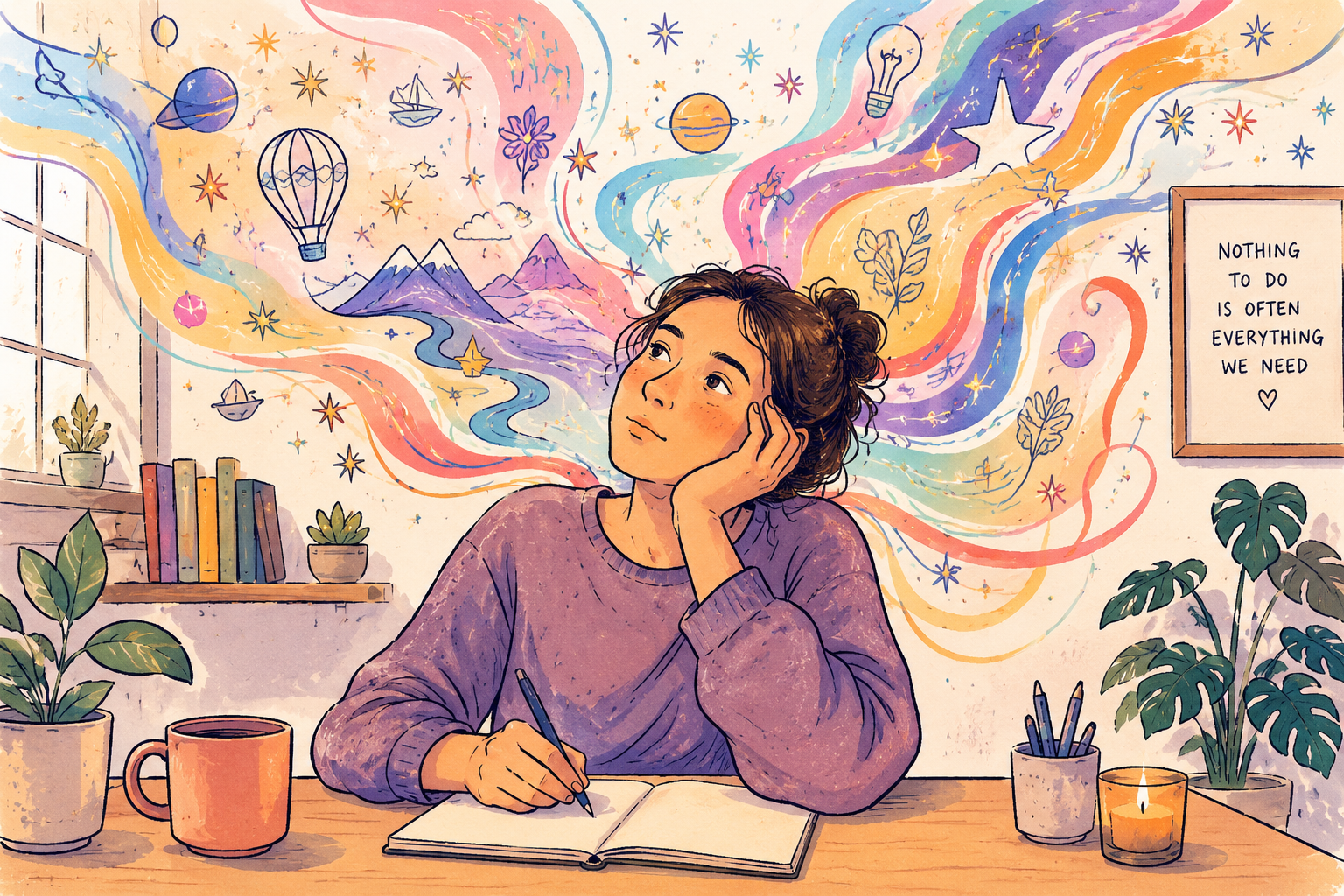
The Lost Art of Being Bored: Why Your Mind Needs Empty Space
Recently, I had a bout of what could be considered boredom on one end of the spectrum and existential crisis on the other, depending on the day and my mood. During this period of about 4-6 weeks I observed on several occasions, my coping strategies or defense mechanisms to try and pop out. Why? Well, it’s not comfortable to be bored! It feels like I’m not going anywhere, producing anything or fulfilling the mandates of my identity. Who am I if not all the things I do? However, being the Yin and Nothing-loving person that I am, I stayed with the boredom, the lack of interest and enthusiasm as consciously as I could. My practice in not trying to shift out of discomfort showed me that actually a lot can happen when I resist choosing activity, hobbies, productivity for the sake of how I think the world needs me to be. Here I am today, not living in a gutter (always a fear when I deviate from the norm!)…and basking in the clarity that boredom provides. So this got me thinking…
When was the last time you were truly bored? Not standing in line while scrolling your phone or listening to a podcast while folding laundry, but genuinely sitting with nothing to occupy your attention? Go ahead, think about it, I’ll wait.
For many of us, those moments have nearly disappeared. We have become experts at filling every quiet space with information, entertainment, or productivity. If there is even a brief pause in the day, our instinct is to reach for our phones.
Wu Wei-Chinese Taoism: effortless action or action in harmony with the natural order
Yet what if boredom isn't something to avoid? What if it is something we've quietly lost—and something our minds and bodies actually need?
Over the past decade, psychologists have begun studying boredom not simply as an unpleasant emotion but as an important mental state. Research suggests that periods of boredom can increase creativity, improve problem-solving, encourage self-reflection, and even help clarify our personal values and long-term goals. Rather than shutting down, the brain begins working differently when it isn't occupied by constant external stimulation.
One study from researchers at the University of Central Lancashire found that participants who completed a deliberately boring task were more creative afterward than those who had not. Neuroscientists have also observed that when our attention is no longer directed toward an external task, the brain activates what is known as the default mode network. During these moments, the mind begins integrating memories, processing emotions, making unexpected connections, and imagining future possibilities. What feels like "doing nothing" is often some of the brain's most valuable work.
These findings resonate deeply with the philosophy of Chinese medicine.
Ma- Japanese: refers to the meaningful space between things
Our modern culture celebrates Yang. Yang is movement, productivity, ambition, achievement, and action. It is the energy that builds businesses, raises families, solves problems, and keeps society moving forward. Yang is essential, but it is only one half of the equation.
Yin is often misunderstood as laziness or inactivity, yet in Chinese medicine Yin is the source of restoration, nourishment, and renewal. Yin is found in silence, stillness, darkness, contemplation, sleep, and simply allowing ourselves to receive rather than constantly produce. The Huangdi Neijing teaches that health depends upon the harmonious relationship between Yin and Yang. Neither is superior; each depends upon the other. Without sufficient Yin, Yang eventually exhausts itself. To heal- we need both Yang and Yin resources.
Our lives today are remarkably Yang-heavy. Even our attempts at rest are filled with activity. We optimize our sleep, listen to educational podcasts while exercising, answer emails over lunch, and scroll through social media while watching television. We have become uncomfortable with empty space because we rarely experience it. But why do we feel uncomfortable when nothing is happening?
Anyone who has intentionally sat in silence knows that boredom can feel surprisingly uncomfortable. Within moments, the mind begins racing. We remember unfinished projects, replay old conversations, and suddenly feel compelled to do something—anything—to escape the stillness. Many people assume this discomfort means they are doing something wrong.
Santosha- Hinduism (yogic philosphy): contentment, not striving to become something else, but resting in what is.
In reality, it may simply be the nervous system adjusting to the absence of constant stimulation.
If we remain present through those first few uncomfortable minutes, something often begins to shift. Creativity emerges. Long-forgotten insights surface. Problems that seemed impossible suddenly reveal a solution. Emotions we have been too busy to acknowledge gently come into awareness. Sometimes boredom is simply the doorway we must walk through before we can hear ourselves again.
Or perhaps, we simply enjoy the moment, the bird song, the colors in the clouds, the feel of the breeze on our face.
Difficulty with quiet and stillness is something I witness often in my acupuncture practice. Many patients arrive feeling anxious, exhausted, disconnected, or overwhelmed. They are not lacking information—they are lacking spaciousness. Their nervous systems have forgotten how to settle into a state where healing can naturally occur.
Friluftsliv- Scandinavian: open-air living, being in nature without needing a purpose
Classical acupuncture offers something increasingly rare in modern life: protected stillness. For an hour there is nowhere to be, nothing to accomplish, and nothing demanding your attention. As the body settles, many people notice their breathing deepen, their thoughts slow, and a quiet sense of ease return. The treatment is not simply about needles; it is about creating the conditions in which the body can remember its own capacity for balance.
This week, I invite you to experiment with boredom. Leave your phone behind during a short walk. Sit outside without reading or listening to anything. Watch the sunset without taking a photograph. Drive somewhere without turning on a podcast. Give yourself ten minutes where nothing needs to happen.
Notice the impulse to fill the silence, and then simply let it pass.
You may discover that boredom is not empty after all. It may be one of the few places left where your deeper mind, your nervous system, and perhaps even your spirit have enough space to speak.
In Chinese medicine, healing is not always about doing more. Sometimes it begins by cultivating enough Yin that life can naturally reorganize itself. In a world that constantly asks us to produce, perhaps boredom is not something to escape but a forgotten medicine waiting patiently to restore our balance.