Love Him Into Flight
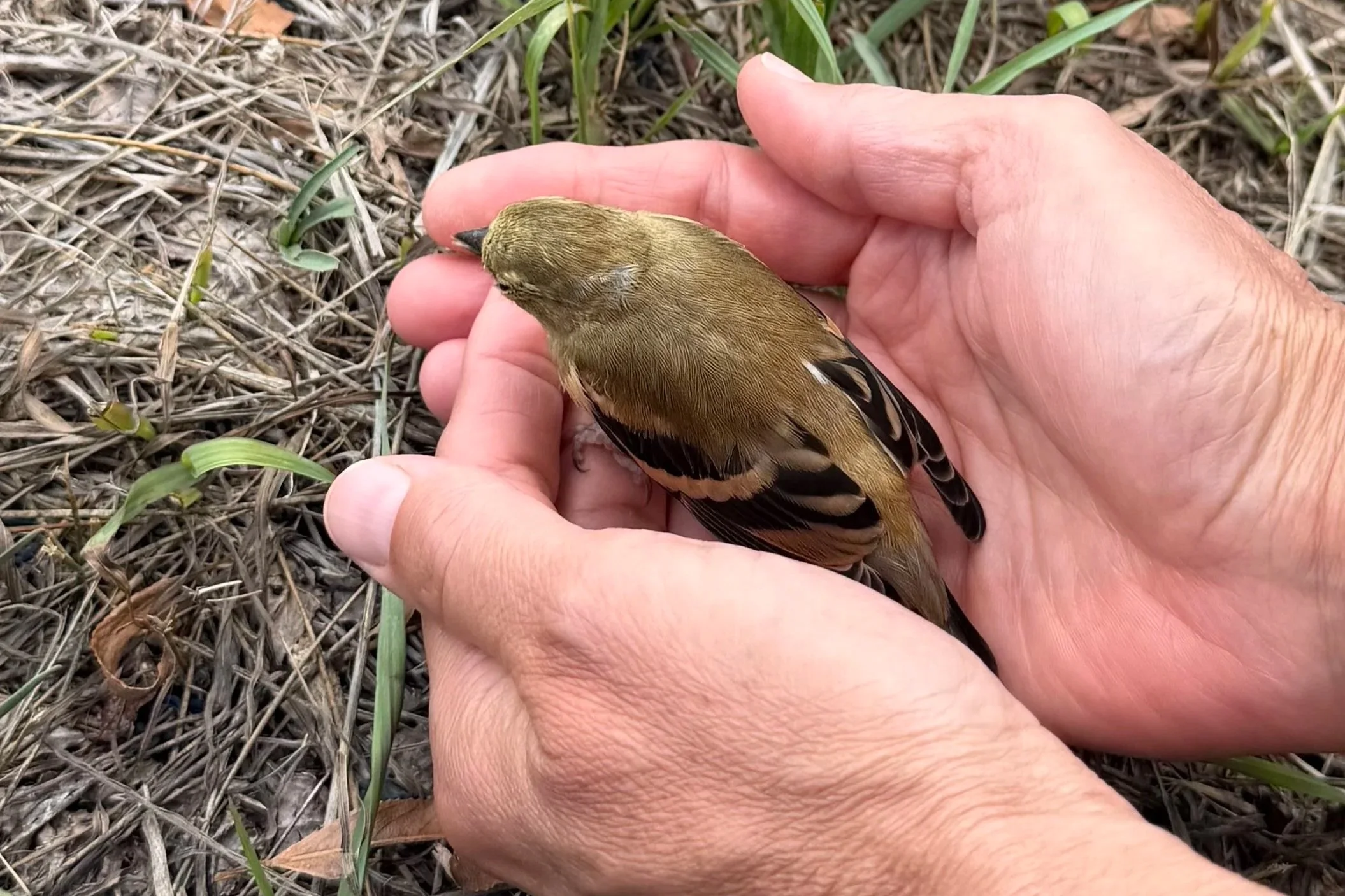
“Fredrico,” the goldfinch, teacher of great healing
I was recently at Joyful Journey Hot Springs, lying in a lounge chair after a long soak. I was warm, relaxed, and feeling particularly grateful for the glass panels surrounding the pool. The wind was blowing hard across the valley, but where I was lying, I was protected.
A short time later, I heard a thump.I looked over and saw a goldfinch lying on the concrete. He had flown directly into the glass. I went to him and gently picked him up. Immediately, I felt sorrow for what had happened. He was so small and vulnerable in my hands, and I could feel the part of me that wanted to grieve for him. But I also had the thought that I didn't want to communicate my fear or sadness to him.
So instead, I allowed my heart to gently expand. I held him and tried, as simply as I could, to communicate: I am here with you. Not poor little thing. Not please don't die. Not even you need to get better.
Just presence.
Over the next thirty minutes or so, he seemed to come around. Eventually, he was able to stand on his tiny legs and wrap his feet around my finger. As I held him, my mind began doing what minds do. It started creating a future. I pictured taking him home with me. I imagined making a little place for him to recover, nursing him back to health and eventually watching him fly away.
I wanted to love him into flight.
But another thought kept arising: this was his home. These trees, this valley, this particular patch of earth were where he belonged. Somewhere nearby might be the other birds he knew. Whatever relationships exist in the mysterious social world of a goldfinch were here—not at my house.
My husband and I talked it over, and eventually we placed him carefully on a tree stump in a protected spot. We left for the day with my prayer that he would continue to regain his strength.
The next day, I happened to be driving through the area again. By then I had convinced myself that if he was still on that stump, I was taking him home. So clearly I remembered those tiny black eyes looking at me. I remembered the vulnerability of his body in my hands. If he was still there, I would scoop him up and care for him. We have a veterinary friend who specializes in avian medicine. I would call him and consult while I made my home finch friendly.
But when I walked back to the stump, there was no sweet little goldfinch waiting for me.
While I admit I did feel some disappointment, mostly I felt peace. And freedom. I imagined him somewhere in the nearby trees, perhaps still resting a little more than usual, but back in the world that belonged to him. For some reason, I decided his name was Federico. Although I suppose there is an equal chance that she was Frederica.
There was another part of the experience that stayed with me. Before the little bird struck the glass, I had been lying there feeling so grateful for it. The glass was protecting me from the wind. Something constructed for my comfort had made my experience better—and moments later, that same thing had injured another living being.
Glass collisions kill enormous numbers of birds. Something nearly invisible to us as a problem can be impossible for a bird to perceive as a barrier. There is something about that realization that breaks my heart. It also feels like a small representation of something much larger. We humans have become remarkably good at arranging the world for our own comfort. We build, illuminate, pave, fence and reshape the land around what works for us, often without recognizing how dramatically those choices affect the other beings who live here. I don’t have any harsh judgement for those who build the barrier… and I have no tidy resolution for that conflict. But I still haven’t reconciled my discomfort and ache of what our “human” comforts cost the winged, fury, swimming, hopping and slithering among us.
Sweet Federico taught me something else that day, too. In the healing arts, people often come to us hurting. Their bodies may be hurting. Their emotions may be hurting. Sometimes something much deeper in them feels broken. There can be an impulse to join them in their suffering—to feel sorry for them, to worry about them, or to desperately want to make everything better.
But I don't believe that is always what healing asks of us. Compassion is different from collapsing into another person's pain. There is a way of standing beside someone that says:
I see what’s happening.
I’m not afraid of it.
I’m here with you.
And I still recognize the life in you that knows how to find its way.
Maybe that is what I was trying to offer that tiny feathered creature as his feet slowly learned to grip my finger again. And maybe there was one final lesson in leaving him there.
Caring for something doesn't always mean taking it home. Sometimes our desire to rescue can quietly become a desire to control the outcome. Sometimes love asks us to help, and sometimes it asks us to trust. To place someone gently back into their own life. To stand nearby without making their healing ours.
And, when the time comes, to open our hands.